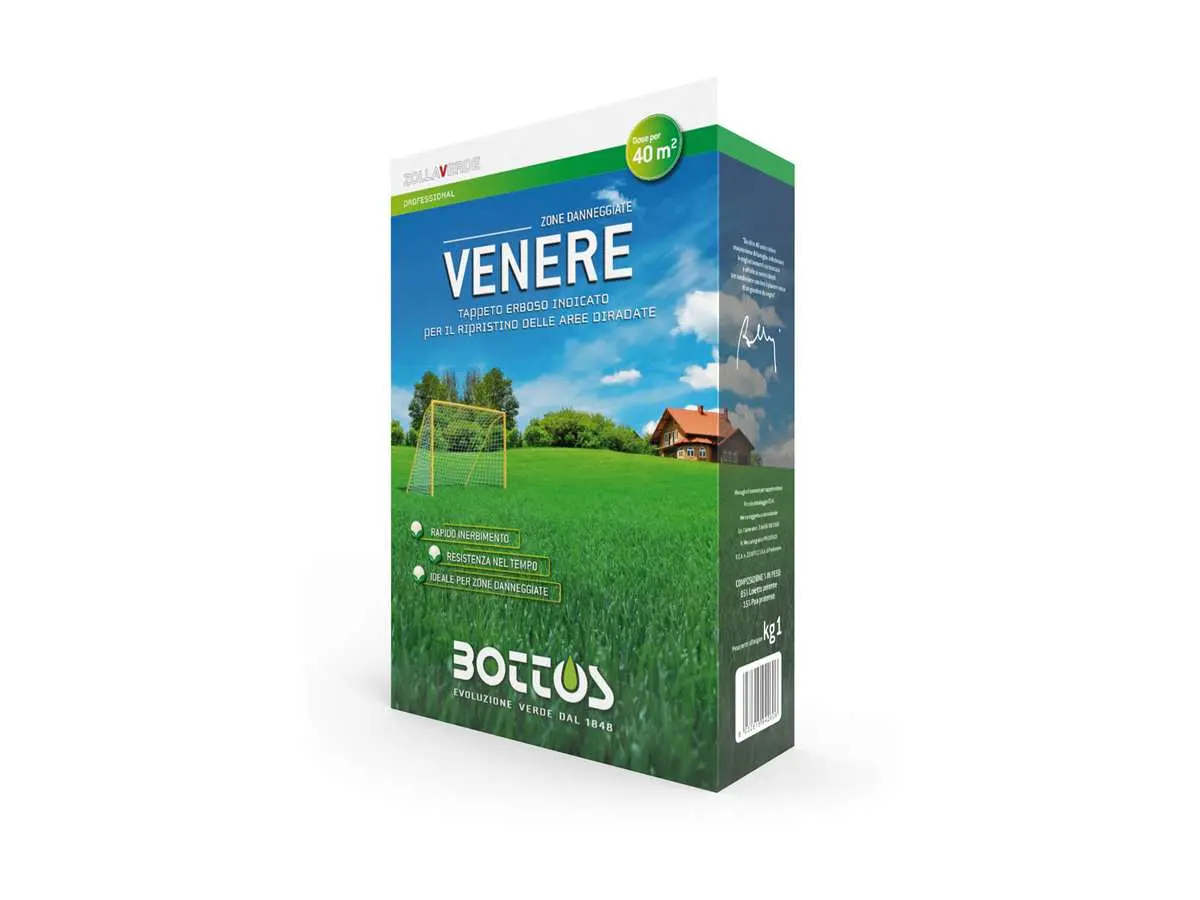

Bottos Seed for damaged lawn areas VENERE - BOTTOS
Code: CUS-47901
Fast delivery with value insured
Secure payments








Other information
- Bottos Venere lawn seeds are a specially designed blend for overseeding and regenerating turf
- Venere is ideal for full sun areas, tolerates partial shade but performance slightly decreases
- New improved American varieties have been included within Venere
- The balance between poa and ryegrass has also been updated to enhance regenerative performance
- This blend consists of a mix of American and European seeds, resistant to trampling, wear, and tearing
- It is a self-regenerating mixture thanks to the robust rhizomes of Poa pratensis
- Venere creates a bright green lawn
- At mature lawn stage, it appears very dense, fine, and uniform
- Tolerant to various fungal diseases such as Powdery Mildew, Red Thread, Dollar Spot, and Microdochium nivale
- 1 kg package
Composition
90% PERENNIAL RYEGRASS PASSION/BERLIOZ
10% POA PRATENSIS SR 2100/JACKPOT
Usage period: February, March, April, May, June, August, September, October, November
Sowing rate: 1Kg = 20-33 sqm (30-50 gr/sqm)
Package Box: 1 Kg
Suitable for: Overseeding / reseeding
Sun exposure: > 70%, Shade > 70%, Mix of shade and sun
Color: Bright green
Maintenance: High frequency
Irrigation system: Recommended
USAGE SUGGESTIONS
Sowing and Dosage: Germination can take from 4 to 10 days, directly related to soil temperatures (soil temperature required above 8°C). The dosage is 30-40 gr/sqm, with maximum doses recommended in case of high temperatures and/or imperfect seedbed preparation. It is recommended to use lawn soil
Mowing: Perform the first cut when the grass reaches 6-8 cm. Never remove more than 30% of the existing vegetation
Irrigation: During sowing and reseeding keep the soil constantly moist until complete germination. For mature lawns, irrigate with 10 mm of water every 2 days during summer. If possible, schedule a thermal irrigation of 1-2 mm daily around 11:00 am in July and August (cooling)
Nutrition: Phosphatic fertilization at sowing followed by planning 4-6 annual fertilizations with at least 30 units of Nitrogen sqm/year, increasing up to 40 units of Nitrogen sqm/year for sports turf. During regular maintenance, limit the use of phosphorus-based fertilizers to avoid possible proliferation of Poa annua
Also schedule 4 biostimulant treatments to increase tolerance to trampling and heat
You might also be interested in View all